The History of the British Shilling and Other Pre-Decimal Coins
For centuries, British life moved to the rhythm of pounds, shillings, and pence. This intricate system of currency, with its unique denominations and complex calculations, was the bedrock of commerce and daily life. The history of the British shilling offers a fascinating window into this pre-decimal world, a story that spans nearly 500 years of monarchy, economic turmoil, and societal change.
From its origins as a silver coin in the Tudor era to its final days before decimalization, the shilling was a cornerstone of the British economy. Understanding its journey, alongside other beloved coins like the farthing, crown, and florin, reveals the rich and complex tapestry of the United Kingdom’s monetary past.
The History of the British Shilling: From Testoon to Decimalization
The shilling’s story is one of evolution, reflecting the changing fortunes and identity of the nation itself. It began not as a shilling, but as a different coin altogether, marking a new chapter in English numismatics.
Origins and Early Development
The forerunner to the shilling was a silver coin called the testoon, first introduced around 1502 during the reign of Henry VII. These early coins were not widely circulated but were significant for being among the first English coins to feature a true-to-life portrait of the reigning monarch.
Under Henry VIII and his son, Edward VI, the coin became a standard part of the currency. During the reign of Edward VI (1547–1553), the name “shilling” was officially adopted. The name itself has ancient roots, deriving from the Old English word ‘scilling’, which meant a unit of account used for reckoning values, referencing a time when payments were made with pieces cut from larger blocks of metal.
Value and Role in the £sd System
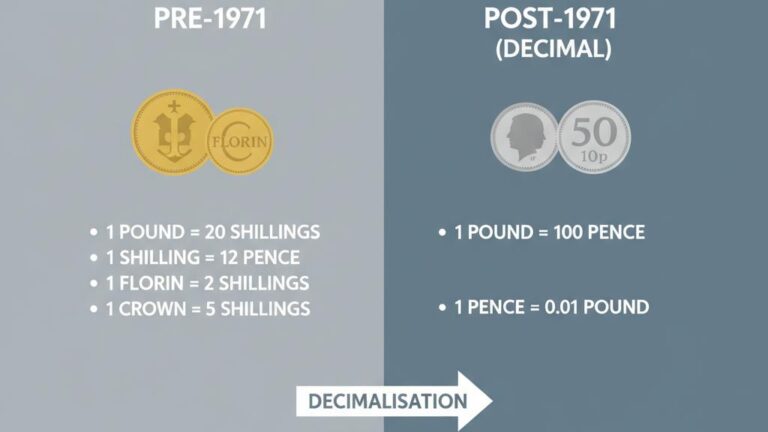
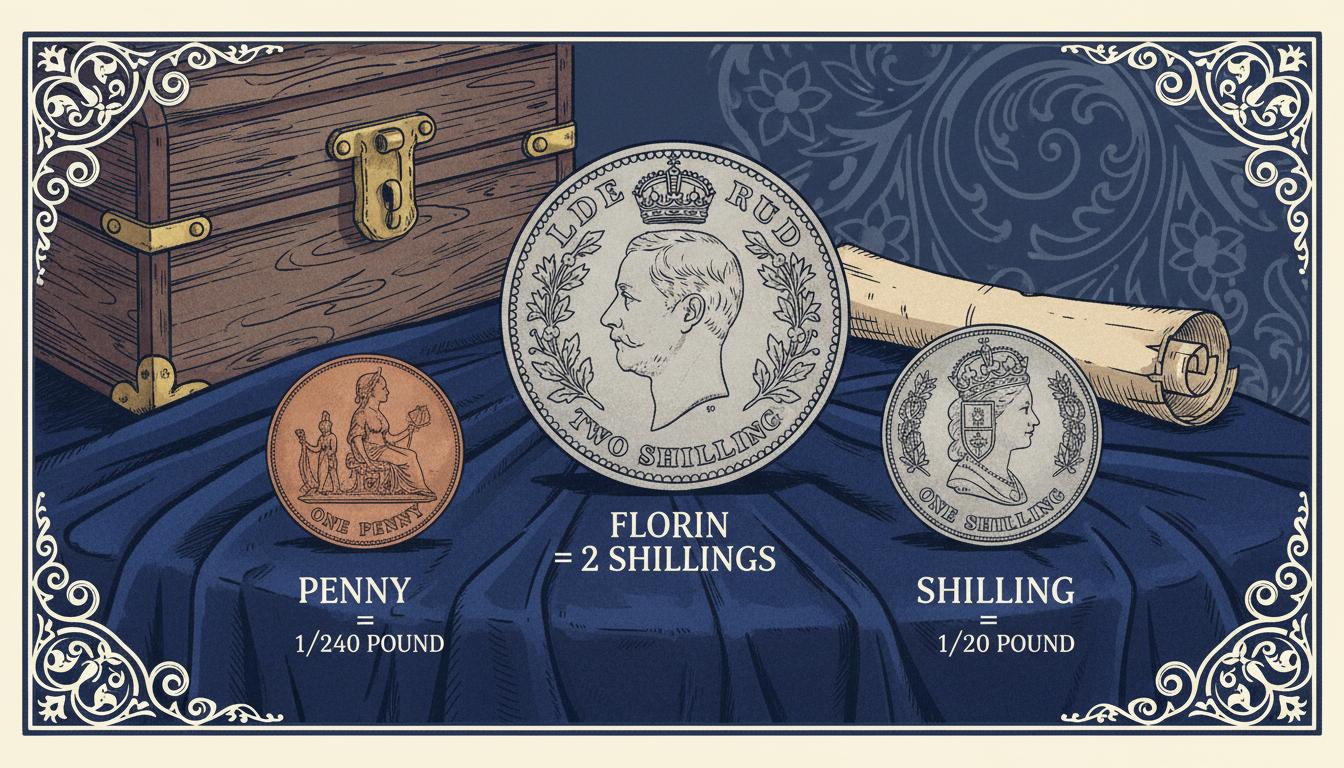
The shilling was a crucial middle-value coin within the pre-decimal currency system, often called the £sd or pounds, shillings, and pence system. Its value was fixed and universally understood:
- 12 pence made one shilling (1s or 1/-).
- 20 shillings made one pound sterling (£1).
This structure meant a pound was comprised of 240 pence. The shilling filled the gap between low-value coins like the penny and farthing and larger silver coins such as the half crown. For a comprehensive overview of the sterling’s long history, you can explore the history of the British Pound Sterling.
Evolution: From English to British Shilling
Initially, the coin was known as the English shilling. This changed following the 1707 Act of Union, which united the kingdoms of England and Scotland. Afterward, it became the British shilling, though Scottish shillings continued to circulate in parallel for a short time.
The coin’s design and composition were not static. They shifted with each new monarch and adapted to the country’s economic needs, creating a tangible timeline of British history that people could hold in their hands.
Material, Debasement, and Recoinage
Originally minted from silver, the shilling’s purity and weight often fluctuated. King Henry VIII famously debased the coinage to fund his extravagant spending, drastically reducing the silver content and causing widespread inflation and a loss of public trust.
Stability was restored during the Great Recoinage of 1816, which standardized the weight and silver content of the shilling and other coins. This reform provided a reliable currency that would last for over a century. However, economic pressures after World War II led to another major change. In 1947, with silver prices soaring, the mint switched to cupronickel, a durable alloy of copper and nickel.
Iconic Designs Through the Ages
Shilling designs are a gallery of royal and national iconography. Each monarch’s reign brought a new portrait to the obverse. The reverse often featured heraldic symbols, such as a crowned lion or royal coats of arms. During the reign of George VI, two distinct versions were even minted: one with an English crowned lion and another with a Scottish lion, reflecting the distinct identities within the United Kingdom.
A Look at Other Old British Coin Denominations
The shilling was just one piece of a complex monetary puzzle. Several other old British coin denominations played vital roles in everyday life, each with its own unique history.
The Smallest Coins: Farthings and Pence
At the bottom of the value scale were the smallest coins, essential for minor purchases.
- Farthing (¼d): The smallest denomination, worth a quarter of an old penny. As inflation rendered its value negligible, the farthing ceased production in 1956 and was withdrawn from circulation entirely in 1961.
- Penny (1d): The basic unit of the system. The origin of the silver penny dates back centuries and formed the foundation upon which the pound was built.
Intermediate Coins: Threepence and Sixpence
Between the penny and the shilling were two other useful coins:
- Threepence (3d): Often called a “thruppence,” this coin was a popular denomination.
- Sixpence (6d): Valued at half a shilling, the sixpence was a widely used and beloved coin, often associated with good luck.
The History of Farthings and Crowns: Larger Denominations
For larger transactions, several silver coins with higher values were used. The history of farthings and crowns shows the wide spectrum of values needed in the pre-decimal economy.
- Florin (2s): Worth two shillings, the florin was introduced in the 19th century as an early move toward decimalization, as it represented one-tenth of a pound.
- Half Crown (2s 6d): A large silver coin valued at two shillings and sixpence, or 30 old pence.
- Crown (5s): The largest silver coin in regular circulation, worth five shillings. By the 20th century, the crown was rarely used in daily commerce and was primarily minted for commemorative purposes.
The Pound Conversion to Decimal and the Shilling’s Demise
The complex system of pre-decimal British currency facts eventually gave way to a simpler, more modern structure. The transition marked the end of a nearly 500-year era for the shilling and its counterparts.
Decimal Day: 15 February 1971
Following the Decimal Currency Act of 1969, the United Kingdom officially switched to a decimal system on what became known as “Decimal Day.” The pound was now divided into 100 “new pence.” The shilling, worth 12 old pence, had a direct and convenient equivalent: the 5 new pence piece. For a time, the new 5p coin was identical in size and weight to the shilling, and old shillings remained in circulation alongside it.
The final regular issue of the shilling was minted in 1970. Though they were gradually phased out, they remained legal tender for nearly two decades after the decimalization of the pound sterling in 1971.
Cultural Legacy and Collectability
Today, the shilling and other pre-decimal coins are artifacts of a bygone era. They are sought after by numismatists and evoke a sense of nostalgia for a time of intricate calculations and distinct monetary traditions. These coins are not just currency; they are emblems of Britain’s economic and political identity, reflecting both its long continuity and its adaptation to the modern world. For more details on British coinage, The Royal Mint Museum provides an authoritative history.
Frequently Asked Questions
What was a British shilling worth in today’s money?
A shilling was worth 1/20th of a pound. After decimalization in 1971, it was replaced by a 5 new pence coin. Its historical purchasing power varied greatly due to inflation, but its value relative to the pound was always fixed.
When did the British shilling stop being used?
The last shilling intended for circulation was issued in 1970. After Decimal Day in 1971, it circulated as a 5p coin until a smaller 5p piece was introduced, leading to the shilling being officially demonetized in 1990.
What is the history of the British farthing and crown?
The farthing (¼ penny) was a small-value coin used from medieval times until its demonetization in 1961. The crown (5 shillings) was a large silver coin that became primarily ceremonial by the 20th century, often issued to mark major royal or national events.
How did Britain’s currency system work before decimalization?
The pre-decimal system was based on pounds (£), shillings (s), and pence (d). The relationships were: 12 pence = 1 shilling, and 20 shillings = 1 pound. This system, also known as the £sd system, required complex arithmetic for daily transactions.
Conclusion
The story of the British shilling is more than just the biography of a coin; it is a reflection of a nation’s history. From its Tudor origins as a silver testoon to its final form as a cupronickel piece interchangeable with its decimal successor, the shilling was a constant in the pockets of the British people for centuries. Alongside the farthing, crown, and florin, it belonged to a rich monetary system that, while complex, was deeply woven into the cultural fabric of the United Kingdom.