The Role of the Reichsbank: Central Banking in Germany’s Turbulent Eras
From the heights of imperial ambition to the depths of economic collapse and moral bankruptcy, few financial institutions have witnessed as much history as Germany’s central bank. Spanning nearly seven decades of immense change, the reichsbank history is a dramatic story of a nation’s journey through unification, war, hyperinflation, totalitarianism, and eventual reconstruction.
The Reichsbank was the central bank of Germany from its creation in 1876 until its dissolution in 1945. It was more than just a monetary authority; it was a critical instrument in shaping German economic policy, a symbol of stability, a tool for war financing, and ultimately, a participant in the crimes of the Nazi regime. Understanding its evolution is key to understanding the modern German commitment to central bank independence.
The Birth of a Central Bank: Unifying Germany’s Currency
The story of the Reichsbank begins with the unification of Germany in 1871. Before this, the German states were a patchwork of economies, each with private and state banks issuing their own currencies. This fragmented system was a major obstacle to national economic integration and industrial growth.
From Prussian Bank to National Authority
To create a modern, unified economy, Germany needed a centralized monetary authority. In January 1876, the Reichsbank was founded in Berlin as the successor to the Prussian state bank. Its creation was driven by a liberal, reform-minded desire for transparent and efficient monetary management.
The core principles behind its establishment were:
- Standardization: To replace the multitude of local currencies with a single, reliable national currency.
- Stability: To anchor the new currency to the gold standard, ensuring its value and fostering international trade.
- Independence: To operate as an apolitical, rule-based institution, free from direct government interference in its day-to-day monetary decisions.
This marked a turning point in the history of German central banking, moving from a decentralized collection of pre-deutsche mark banks to a powerful national institution.
The Goldmark and Economic Expansion
The Reichsbank was responsible for issuing the German Mark, often called the Goldmark, which was pegged to gold. This stable currency became the foundation for Germany’s rapid industrial expansion during the late 19th and early 20th centuries. The bank regulated cash and credit, providing the financial stability necessary for businesses to thrive and for Germany to integrate into the global economy.
The influence of this new, uniform monetary system extended even into Germany’s colonies, where local variations of the Mark circulated, cementing the Reichsbank’s role as the financial heart of the German Empire.
The Great War and the Specter of Hyperinflation
The principles of independence and stability that defined the Reichsbank’s early years were shattered by the outbreak of World War I. The immense financial demands of the war effort forced the bank to abandon its apolitical stance and become an instrument of the state.
Financing the War and Losing Independence
During the war, the Reichsbank’s primary function shifted to financing the German government’s massive military expenditures. It monetized huge state borrowings, essentially printing money to cover war debts. This process severed the Mark’s link to the gold standard and led to significant inflation, eroding the currency’s value.
The bank lost much of its institutional independence, becoming subordinate to the fiscal needs of the wartime government. This set a dangerous precedent for political interference in monetary policy, a problem that would spiral out of control in the post-war years.
The 1922-23 Hyperinflation Crisis
After Germany’s defeat, the nation was burdened with heavy war reparations imposed by the Treaty of Versailles. Combined with political instability and the government’s continued reliance on the printing press, this created the perfect storm for one of history’s most infamous economic disasters.
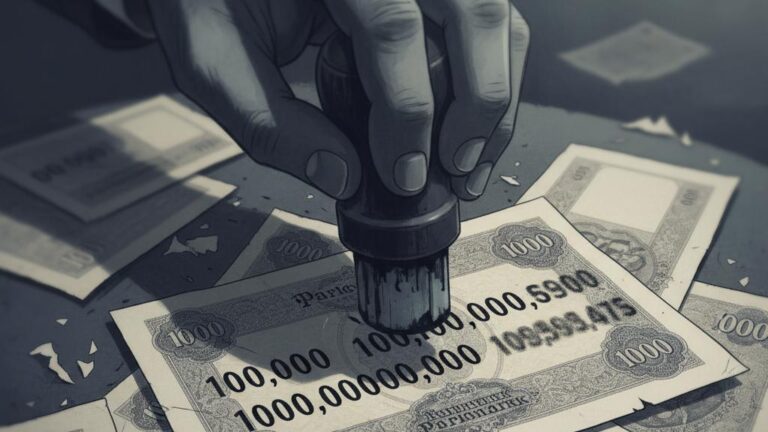
The hyperinflation of 1923 completely destroyed the value of the German currency, wiping out the savings of millions of citizens and causing widespread social and economic chaos. The Reichsbank, under intense political pressure, was a key agent in this collapse.
Stabilization and a Return to Order
To halt the economic freefall, drastic measures were needed. A temporary currency, the Rentenmark, was introduced to restore public confidence. This was followed by the 1924 Dawes Plan, an international agreement that restructured Germany’s reparation payments and provided foreign loans to stabilize the economy.
The Dawes Plan was critical for the stabilization of the Rentenmark and the subsequent Reichsmark. Crucially, it restored the Reichsbank’s institutional independence, a move seen as essential to prevent a repeat of the hyperinflation crisis. In 1924, the bank issued the new Reichsmark, replacing the worthless Papiermark and ushering in a period of relative economic stability during the Weimar Republic.
The Darkest Chapter: The Reichsbank During WWII
The restored independence of the Reichsbank was short-lived. With the rise of the Nazi Party, the central bank was once again co-opted for political purposes, eventually becoming a vital cog in the regime’s war machine and its genocidal policies. The reichsbank history during this period is a cautionary tale of institutional complicity.
Erosion of Independence Under the Nazis
Under the leadership of its president, Hjalmar Schacht, the Reichsbank initially played a key role in Germany’s economic recovery and rearmament efforts. However, as Adolf Hitler consolidated power, the bank’s autonomy was systematically dismantled. By 1939, the Reich government had asserted direct authority over the institution.
In 1939, Hitler placed the Reichsbank under his direct personal control, appointing Walther Funk as its final president. The bank was no longer an independent monetary authority but a direct tool of the Nazi state, fully dedicated to financing its expansionist and ideological goals.
Complicity in War Crimes and the Holocaust
During World War II, the Reichsbank’s role became deeply sinister. As documented by extensive historical research, including studies supported by Germany’s modern central bank, the Deutsche Bundesbank, the bank was instrumental in the Nazi regime’s crimes. Its key functions included:
- Armament Financing: It provided the financial architecture for Germany’s massive rearmament program.
- Exploiting Occupied Territories: The bank financially exploited conquered nations, draining their resources to fuel the German war effort.
- Processing Looted Assets: The Reichsbank knowingly accepted, processed, and sold assets seized from Jewish citizens and others targeted by the regime.
- Laundering “Victim Gold”: Most horrifically, the bank accepted and laundered gold and other valuables taken from individuals murdered in concentration camps. This “victim gold,” which included dental gold, was melted down and integrated into the nation’s reserves, as detailed by organizations like the Bank for International Settlements.
Dissolution and Legacy: Lessons from the Past
Following Germany’s defeat in World War II, the Allied powers dissolved the Reichsbank in 1945. Its name was irrevocably tainted by its role in the Nazi regime. However, the history of German central banking did not end there; instead, it was rebuilt on the lessons learned from the Reichsbank’s triumphs and, more importantly, its catastrophic failures.
In the immediate post-war period, its functions were handled by decentralized regional banks. In 1948, the Bank deutscher Länder was established in West Germany, which was succeeded by the Deutsche Bundesbank in 1957. The structure and mandate of the Bundesbank were profoundly influenced by the Reichsbank’s past.
The architects of the post-war German economy recognized the immense danger of a central bank controlled by political interests. As a result, the Bundesbank was established with a powerful, constitutionally guaranteed independence, making price stability its primary and overriding mandate. This deep-seated aversion to inflation and political interference, a direct legacy of the Weimar hyperinflation and Nazi era, became a cornerstone of Germany’s post-war economic identity and a model for central banks worldwide. According to scholars at institutions like the Economic History Association, this legacy continues to shape German economic thought today.
Frequently Asked Questions
What was the Reichsbank and why was it important?
The Reichsbank was Germany’s central bank from 1876 to 1945. It was important for unifying the country’s currency system, managing monetary policy, and influencing economic development through the German Empire, the Weimar Republic, and the Nazi regime.
How did the Reichsbank contribute to hyperinflation in the 1920s?
During and after World War I, the Reichsbank monetized massive amounts of state debt to pay for the war and reparations. This policy of printing money, combined with political turmoil, led to the hyperinflation of 1923, which destroyed the value of the German currency.
What role did the Reichsbank play during the Nazi era?
Under Nazi control, the Reichsbank lost its independence and became an instrument of the regime. It financed rearmament, managed looted assets from occupied countries, and processed gold and valuables stolen from victims of the Holocaust.
What happened to the Reichsbank after World War II?
The Allied powers dissolved the Reichsbank in 1945. It was eventually replaced by the Bank deutscher Länder in 1948 and then by the Deutsche Bundesbank in 1957, which became the central bank of West Germany.
How has the Reichsbank’s history influenced modern German central banking?
The Reichsbank’s history, particularly its loss of independence leading to hyperinflation and its complicity in Nazi crimes, created a strong belief in Germany that a central bank must be independent from political control. This principle is a core tenet of its successor, the Deutsche Bundesbank.
Conclusion: A Dual Legacy
The history of the Reichsbank is a story of two starkly different institutions. In its early decades, it was a force for modernization, creating a stable monetary foundation that fueled Germany’s rise as an industrial power. In its final years, it became a morally compromised tool of a totalitarian state, facilitating war and participating in unimaginable theft.
This dual legacy left an indelible mark on Germany. The country’s subsequent commitment to an independent central bank focused solely on price stability is a direct response to the catastrophic failures of the Reichsbank. By studying its complex history, we gain crucial insights into the evolution of central banking and the enduring importance of institutional independence.
To learn more about the specific currencies managed by the Reichsbank and its successors, explore our detailed guide on the history of the German Mark, Reichsmark, and Deutsche Mark.