The History of the Big Mac Index: Global Currency Value Comparison
Can a fast-food hamburger truly explain complex global economics? For decades, the answer has been a resounding, if slightly humorous, “yes.” The big mac index history begins not in a boardroom of economists but within the pages of a magazine, offering a surprisingly insightful and digestible way to understand currency values across the globe.
This simple tool, born from a desire to make a tricky economic theory accessible, uses McDonald’s flagship burger to compare currencies and purchasing power. It serves as a real-world litmus test for whether a country’s exchange rate is fair, overvalued, or undervalued against another. Let’s explore how this concept of “burgernomics” came to be and what it can still teach us today.
The Birth of Burgernomics: A Brief Big Mac Index History
The Big Mac Index was created by The Economist magazine in 1986. The concept was brought to life by editor Pam Woodall, who envisioned it as a semi-humorous yet powerful tool to illustrate the theory of purchasing power parity (PPP) for a general audience.
The core idea behind PPP is that, in the long run, exchange rates should adjust so that an identical basket of goods and services costs the same everywhere. However, comparing vast and differing national “baskets” is incredibly complex. The genius of the Big Mac Index was using a single, globally recognized product—the McDonald’s Big Mac—as a simplified proxy for this basket.
Because McDonald’s has a massive global footprint, the Big Mac is available in dozens of countries and is made with relatively standardized ingredients and production methods. This makes it a near-perfect item for a quick and dirty comparison of local prices and, by extension, currency valuations.
How the Big Mac Index Calculation Works
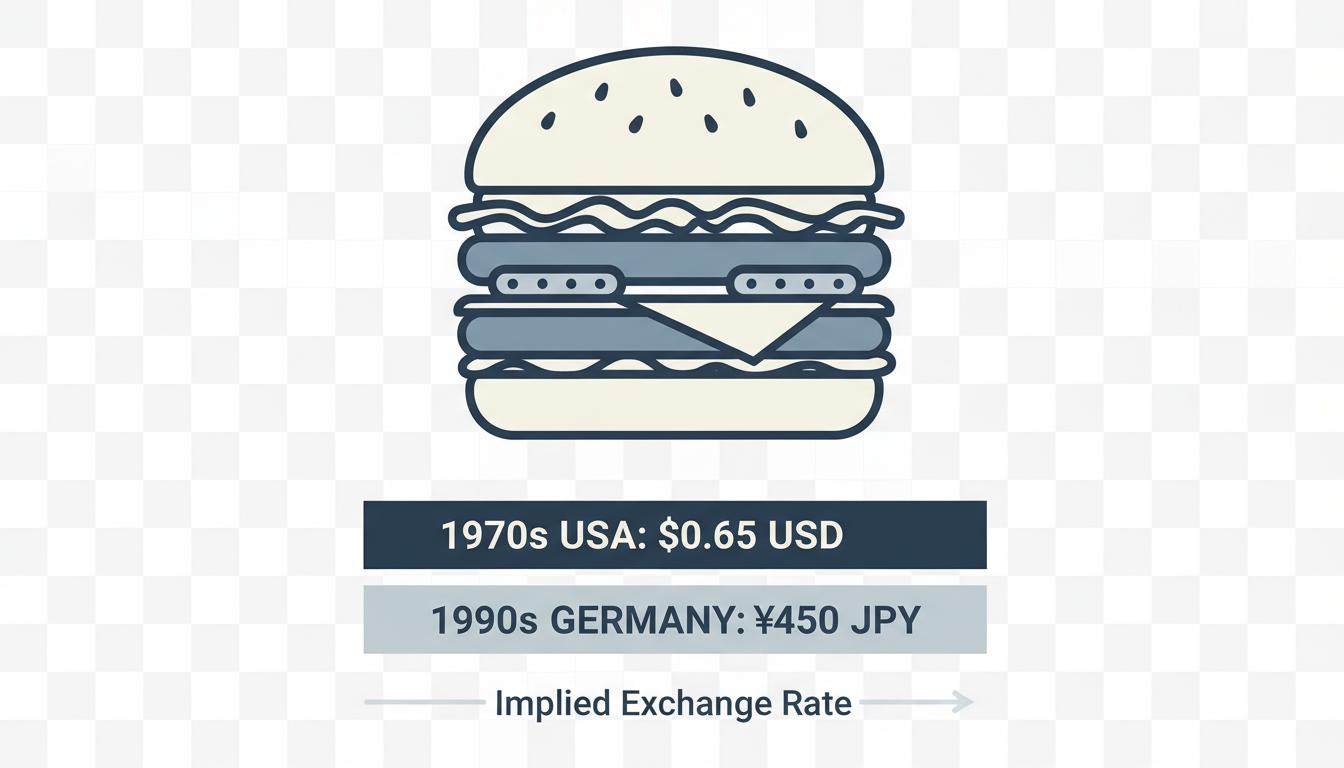
The elegance of the Big Mac Index lies in its straightforward calculation. It aims to determine the “implied” exchange rate between two currencies based on the price of a Big Mac in each country.
Here’s the basic process:
- Establish a Base Currency: The index typically uses the United States and the U.S. dollar as the benchmark.
- Gather Local Prices: The price of a Big Mac is recorded in various countries in their local currencies.
- Calculate the Implied PPP Rate: You divide the local price of a Big Mac in one country by the price of a Big Mac in the base country (e.g., the U.S.). For example, if a Big Mac costs ¥700 in Japan and $5.50 in the US, the implied PPP exchange rate is ¥700 / $5.50 = 127.27 yen to the dollar.
- Compare to the Market Exchange Rate: This implied rate is then compared to the actual market exchange rate. If the implied rate is higher than the market rate, the local currency is considered undervalued. If it’s lower, the currency is overvalued.
This simple formula provides a snapshot of whether a currency is trading at its “correct” level according to the theory of purchasing power parity. The data is regularly updated and published by The Economist, with some platforms offering regular updates and historical data tracking back to earlier years.
Is the Big Mac Index Accurate? Strengths and Limitations
While widely referenced in news reports, academic papers, and even policy discussions, the Big Mac Index is not a perfect economic instrument. Its simplicity is both its greatest strength and its primary weakness. Understanding its limitations helps clarify its role as an educational tool rather than a rigorous metric for official decision-making.
The Strengths of Burgernomics
- Accessibility: It makes the complex theory of PPP easy for anyone to understand.
- Cost-Effective: Gathering the price of one item is far simpler and cheaper than compiling data on thousands of goods and services for official PPP calculations.
- Long-Term Predictive Value: Research has shown that the Big Mac Index can track historical exchange rates and currency valuations reasonably well over medium to long-term horizons. It often provides better predictive value than traditional random walk models.
Key Criticisms and Limitations
The index’s accuracy can be skewed by several local factors that have little to do with pure currency valuation. These deviations highlight why it should be taken with a grain of salt.
- Local Economic Factors: The price of a Big Mac is influenced by non-tradable local costs like wages, rent, taxes, and supply chain efficiencies. A Big Mac might be cheaper in a developing country not because its currency is undervalued, but because labor and rent costs are significantly lower.
- Single-Product Basket: A single hamburger is not representative of an entire economy’s price levels. Official PPP calculations, like those from the World Bank, use thousands of different goods and services to create a more comprehensive picture.
- Market Anomalies and Manipulation: In some cases, the price can be distorted. A famous example occurred in Argentina, where the government allegedly pressured McDonald’s to keep the price of the Big Mac artificially low to make the currency appear stronger in the index’s rankings.
- Cultural and Dietary Differences: In countries with a limited McDonald’s presence or where the Big Mac isn’t a popular item, the price may not accurately reflect general consumer costs.
Evolution and Fun Historical Currency Comparison Indices
Over its history, the Big Mac Index has inspired several variations and competitors, yet none have achieved its global recognition. The enduring appeal of “burgernomics” rests on the unique combination of the Big Mac’s global reach and cultural resonance.
Index Variations
Recognizing the limitations of the raw index, The Economist later introduced a version adjusted for GDP per person. This helps account for the fact that labor-intensive services and goods are naturally cheaper in poorer countries, providing a more nuanced view of currency valuation.
Other analyses have used the data to measure worker affordability by calculating how many hours someone on an average wage must work to afford a Big Mac in different countries. This shifts the focus from currency valuation to a more direct measure of local purchasing power.
Other Playful Indices
The success of the Big Mac Index has led others to create analogous indices based on globally available products:
- The Starbucks Latte Index: Compares the price of a tall latte across different cities.
- The IKEA Billy Bookcase Index: Uses the price of the iconic bookshelf to compare purchasing power.
- The Chai Latte Index: Another coffee-based comparison intended as a fun alternative.
Despite these attempts, none have matched the Big Mac Index’s fame. The burger’s standardized production process and its presence in over 100 countries make it a uniquely reliable, if imperfect, global benchmark.
The Burger Behind the Index
Interestingly, the Big Mac itself has a rich history that predates the index by nearly two decades. It was invented in 1967 by Jim Delligatti, a McDonald’s franchisee in Uniontown, Pennsylvania. Delligatti wanted a larger burger to compete with rival offerings.
Corporate headquarters was initially skeptical of the new creation, but its local success was undeniable. The “Big Mac” name was coined by Esther Glickstein Rose, a 21-year-old secretary, and the burger was rolled out nationally in 1968, eventually becoming McDonald’s signature product worldwide.
Frequently Asked Questions
How is the Big Mac Index calculated?
The index calculates the implied exchange rate by dividing the price of a Big Mac in one country (in local currency) by its price in another (typically the US), then compares this rate to the actual exchange rate to determine if a currency is under- or over-valued.
What is the theory of purchasing power parity (PPP)?
PPP holds that, over time, exchange rates should adjust so that an identical good (like a Big Mac) costs the same in all countries; the Big Mac Index uses the burger as a simple ‘basket of goods’ to demonstrate this principle.
How accurate is the Big Mac Index as an economic indicator?
Although simplified and sometimes distorted by local factors or market anomalies, research indicates the Big Mac Index can track currency valuation and exchange rate trends well over medium to long horizons, but it is less reliable for short-term prediction or rigorous economic comparison.
What are some criticisms or limitations of the Big Mac Index?
Critics note that using only one product ignores diverse consumption patterns, and that local pricing can be influenced by wages, rent, taxes, and manipulation (as in Argentina), making the index less precise than official PPP calculations.
Conclusion: A Legacy of Digestible Economics
The history of the Big Mac Index is a testament to the power of a simple idea. Born as a lighthearted guide, it has evolved into a globally recognized benchmark for illustrating complex economic theories. While it will never replace comprehensive economic models, its value lies in its ability to make concepts like purchasing power and currency valuation accessible to everyone.
For over three decades, “burgernomics” has provided a valuable starting point for conversations about global finance and helped countless people better understand the dynamics of the historical purchasing power value over time. It remains a fun, insightful, and remarkably enduring tool for comparing the world, one burger at a time.