The History of Money as Debt: Chartalism and State Theory of Money

What if the story of money you’ve always heard—that it evolved from barter to solve the inconvenience of trading chickens for shoes—is fundamentally wrong? This common narrative paints money as a neutral commodity, a simple tool for exchange. But a deeper look into monetary history reveals a far more complex and politically charged reality.
The historical record suggests that for most of human history, money has been a system for accounting for debts. The money as debt history is not a fringe idea but a foundational concept in economics known as the credit theory of money, which posits that money is not a thing of intrinsic value but rather a social relationship—an IOU. This framework, particularly the state theory of money, or Chartalism, explains why the paper in your wallet has value and how it’s intrinsically linked to state power and taxation.
The Credit Theory of Money: A Foundational Challenge
The conventional story of money’s origin, popularized by economists like Adam Smith, begins with barter. The problem with barter, the theory goes, is the “double coincidence of wants”—you have to find someone who has what you want and wants what you have. Money, in the form of a valuable commodity like gold, supposedly emerged to solve this problem.
However, the credit theory of money turns this narrative on its head. First formalized in the early 20th century and further developed by economist A. Mitchell-Innes around 1913, this theory argues that money did not originate as a medium of exchange but as a unit of account to track debts.
In his seminal 1913 paper, Innes stated, “Credit and credit alone is money. Credit is simply the correlative of debt. What A owes to B is A’s debt to B and B’s credit on A.” In this view, every monetary transaction is an exchange of a good or service for a credit—a promise of future payment. The value of this credit doesn’t depend on any physical commodity but on the legal right of the creditor to be paid and the obligation of the debtor to pay.
Ancient Origins: Debt Before Coinage
Anthropological and historical evidence overwhelmingly supports the credit theory. Long before the first coins were ever struck, sophisticated systems of debt and credit existed.
- Mesopotamia and Egypt (c. 4,000–5,000 years ago): Complex societies formalized social obligations and claims. Debts were measured and accounted for in units like grain and silver, thousands of years before these materials were used as currency.
- Social Ledgers: In these archaic societies, money was a social tool. It existed as a ledger of obligations within a community, solidifying relationships rather than facilitating anonymous transactions.
These early systems demonstrate that debt is a far older and more fundamental economic concept than physical currency. Money’s first and primary function was to act as a unit of account to denominate these debts.
The Military Catalyst in Money as Debt History
If debt systems worked for thousands of years, why did states invent coinage? According to the research of anthropologist David Graeber, author of Debt: The First 5,000 Years, the answer lies in state violence and military necessity. The creation of coinage around 2,600 years ago was a revolutionary step driven by the needs of large, expansionist states.
The State Theory of Money
Early states faced a logistical nightmare: how to provision and pay large, standing armies. Traditional credit systems, based on personal trust and community relationships, were insufficient for funding vast military campaigns far from home. States needed a way to standardize and transfer debt obligations impersonally and on a massive scale.
The solution was coinage. Coins were not valuable only because of the metal they contained; they were valuable because they were standardized, state-issued tokens representing a debt the state owed to its soldiers. By paying soldiers in these tokens, the state could provision them anywhere by demanding that local populations accept the coins as payment for supplies. This transformed money from a personal IOU into a universal, transferable IOU from the state itself.
Chartalism Explained: How Taxes Drive Money’s Value
This leads directly to the core idea of Chartalism, a key component of the state theory of money. Chartalism posits that money is a creation of the law (“charta” is Latin for ticket or token) and its value is driven by the state’s power to demand it as payment for obligations.
Here’s how the mechanism works:
- The State Imposes an Obligation: The sovereign power (a king, government, or state) imposes a tax, fee, or fine on its population.
- The Obligation is Payable Only in State Currency: The state dictates that this obligation can only be settled using its own issued currency (its IOUs).
- Demand is Created: Citizens now have a need to acquire the state’s currency to pay their taxes and avoid punishment. This creates a baseline demand for the currency, giving it value.
This cycle demonstrates the deep connection between fiat money and state power. The state first spends its currency into the economy to purchase goods and services (like paying soldiers or funding public works), and then it collects that currency back through taxation. This loop ensures the currency circulates and remains valuable. It’s a system seen throughout history, from ancient empires to the earliest forms of paper money like China’s “flying money,” which was also tied to tax collection.
From Gold to Fiat: The Modern Era of Debt-Based Money
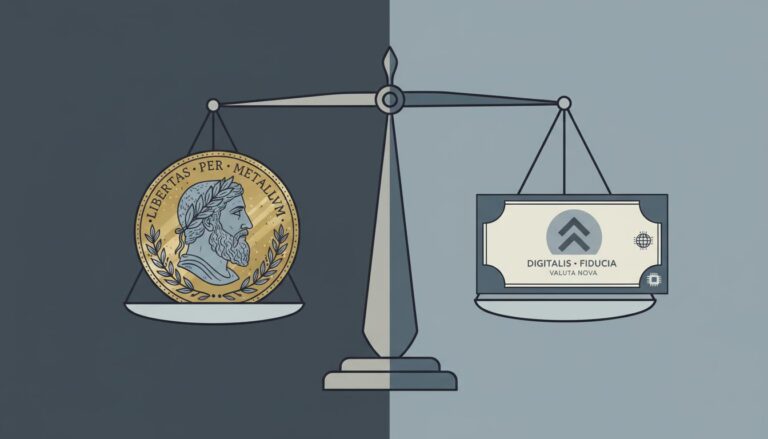
For certain periods, such as under the gold standard, monetary systems were backed by bullion. During these times, the population perceived that money derived its value from precious metals. However, credit theorists argue this perception obscured the underlying debt-based reality.
The illusion was shattered in 1971 with the “Nixon Shock.” President Richard Nixon formally suspended the link between the U.S. dollar and gold, effectively ending the Bretton Woods system. This event marked the official transition to a global fiat system.
Since 1971, the world’s monetary system has been explicitly and entirely fiat-based. No scarce commodity backs our money—only the authority of governments and the issuance of bank credit. In the contemporary system:
- Public Debt Supports Base Money: Central banks may buy government debt, which can increase the monetary base, but not every dollar of base money is created strictly through new public debt.
- Private Debt Creates Broad Money: Commercial banks create the vast majority of “broad money” by issuing loans, which simultaneously creates a deposit (money) and a debt for the borrower.
Modern Interpretations: MMT and the Hierarchy of Assets
The principles of Chartalism and the credit theory have been integrated into a contemporary framework known as Modern Monetary Theory (MMT). MMT combines the Chartalist position that money is a state IOU with the principle that all state money is also credit money. It emphasizes that a government that issues its own currency cannot involuntarily go bankrupt, as it can always create the money needed to pay its debts—a direct consequence of the history of fiat currency.
Economist Perry Mehrling provides a useful way to visualize this system with his “hierarchy of assets.” He positions assets from most to least tangible:
- Gold: The ultimate tangible asset.
- Currency: An IOU from the central bank.
- Deposits: An IOU from a commercial bank.
- Securities: An IOU from a corporation or other entity.
The lower you go down this hierarchy, the more clearly the asset is just someone else’s debt. Our modern economy operates on these multiple, interlocking layers of credit and debt.
Were There Ever Debt-Free Monetary Systems?
While debt appears central to money’s story, there have been historical exceptions. During long stretches of Western civilization, from ancient Greece and Rome until the 1700s, currency was often “spent” into circulation by sovereigns. This process created genuine seigniorage—profit made by a government by issuing currency—that was free of interest and redemption obligations.
Instruments like wooden tallies, used in England for centuries, functioned as credit instruments that extended the coin base while technically creating obligations to accept them for tax payments, which is a form of social debt distinct from modern interest-bearing debt. These systems operated on a principle of complementary claims and duties between the sovereign and subjects, a different model from today’s debt-based creation.
Frequently Asked Questions
What is the credit theory of money, and how does it differ from traditional monetary theory?
Credit theory posits that money originated as a system for accounting debts, with monetary units representing obligations rather than intrinsic value. Unlike traditional theories emphasizing money’s role as a medium of exchange backed by commodities like gold, credit theory argues that money is fundamentally a legal relationship between creditor and debtor. This framework explains why modern money has value despite lacking commodity backing—it represents a claim on future goods or services and is sustained by the state’s willingness to accept it for taxes and fees.
How did the Nixon Shock in 1971 change the nature of modern money?
The Nixon Shock ended the Bretton Woods system, which linked government currencies to gold reserves. Before 1971, money theoretically derived value from its redeemability in gold. After 1971, money became entirely fiat-based, with no commodity backing. This transformation made explicit what credit theorists had argued all along: money’s value rests on social and legal obligations and state acceptance, not precious metals. Today, new dollars are created primarily through the extension of credit by private banks, while central banks manage the base supply in relation to policy goals.
Why did states originally create coinage, according to historical research?
According to research by anthropologist David Graeber, states created coinage to standardize and quantify the debt owed to soldiers financing large armies. Traditional debt-based systems, which relied on personal relationships and trust, proved insufficient for funding warfare and territorial expansion. Coins solved this problem by providing standardized, transferrable tokens representing a universal debt obligation, enabling states to mobilize resources and compensate soldiers efficiently.
Conclusion
The history of money is not a simple evolution from barter to bitcoin. It is a story of power, obligation, and social engineering. Understanding the money as debt history reveals that currency is not a neutral tool but a “creature of the state,” as Chartalists would say. Its value is fundamentally tied to the state’s authority to impose taxes and the intricate web of public and private debt that underpins our entire economic system.
By grasping that money is first and foremost a system of IOUs, we gain a clearer perspective on everything from government finance to the nature of banking. The dollar in your pocket isn’t just a piece of paper; it’s a token representing a complex network of credit and debt relationships that has been thousands of years in the making.