Modern Monetary Theory (MMT) and the History of Government Spending
Have you ever heard a politician compare a government’s budget to a household’s? It’s a common analogy: spend more than you earn, and you’ll go broke. But what if this comparison is fundamentally flawed for governments that issue their own currency? This is the central question addressed by a provocative economic framework, and understanding the modern monetary theory history is key to grasping its radical implications.
Modern Monetary Theory (MMT) is a heterodox macroeconomic school of thought that reframes how we understand government spending, debt, and taxes in countries with sovereign currencies, like the U.S. dollar or the Japanese yen. It argues that such governments are not financially constrained in the same way households or businesses are. Instead of asking, “How do we pay for it?” MMT prompts us to ask, “Do we have the real resources—labor, materials, and technology—to accomplish our goals without causing inflation?”
What Is Modern Monetary Theory (MMT)? A Simple Explanation
At its core, MMT provides a description of how a modern fiat money system actually works. Its proponents argue that conventional economics often misunderstands the operational realities of government finance. While the theory is complex, its foundational ideas can be explained simply.
The core tenets of MMT include:
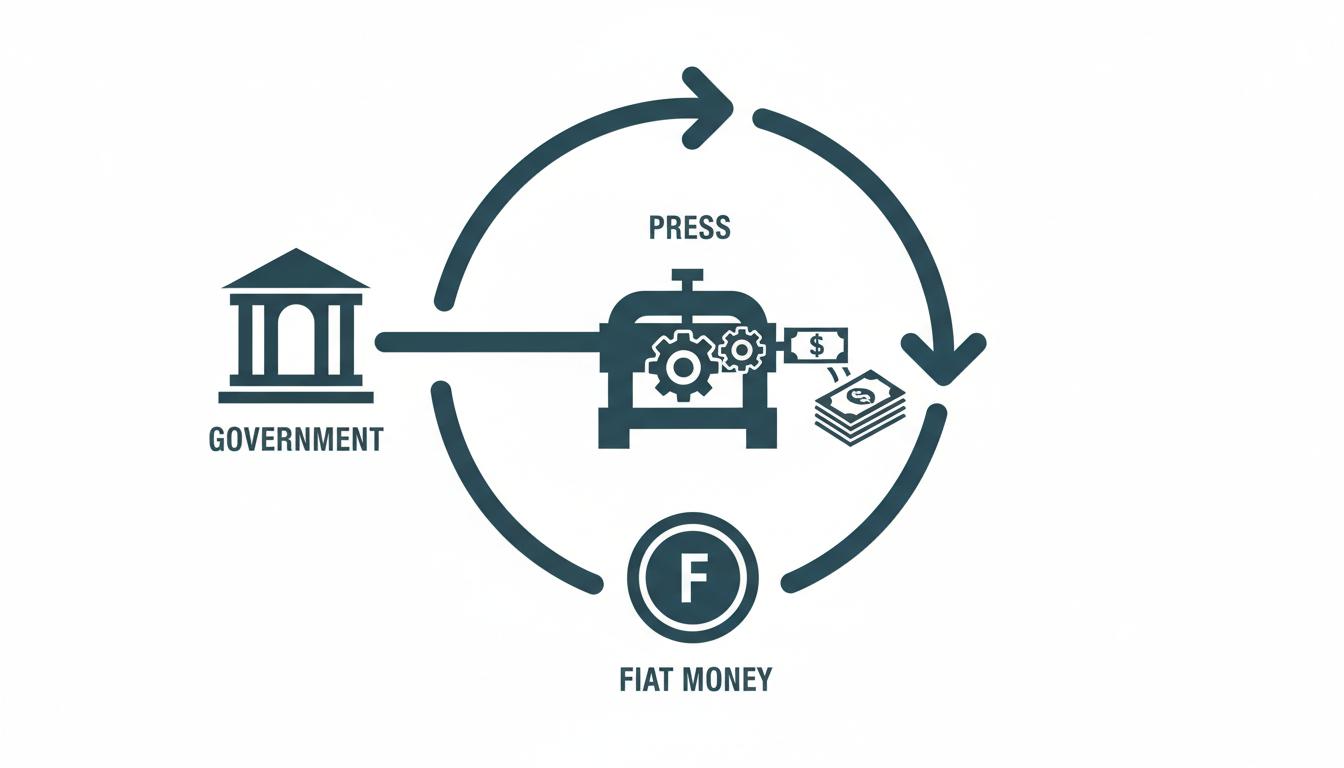
- Sovereign currency issuers cannot “run out” of money. A government that controls its own currency, like the United States, can always create more money to pay its bills. It spends by simply crediting bank accounts, an act that does not require it to first collect taxes or borrow.
- Inflation is the real constraint on spending. The true limit to government spending isn’t a budget deficit but the productive capacity of the economy. If spending outpaces the availability of real resources (labor, factories, raw materials), it can lead to inflation.
- Taxes do not fund spending. In the MMT framework, taxes serve two primary purposes: they create a demand for the government’s currency (since citizens need it to pay their taxes) and they help control inflation by removing money from the private sector.
- Government deficits can be beneficial. A government deficit adds net financial assets to the private sector, which can stimulate demand and drive economic growth. Sovereign debt is simply a record of the private sector’s savings.
Uncovering the Modern Monetary Theory History and Its Roots
While MMT gained prominence in the 21st century, its intellectual roots run deep, synthesizing insights from several earlier economic schools of thought. It is not a single new idea but a comprehensive framework built on a century of heterodox economic thinking.
Chartalism (The State Theory of Money)
The earliest foundation of MMT comes from German economist Georg Friedrich Knapp, who published The State Theory of Money in 1905. Knapp argued against the idea that money evolved from barter. Instead, he proposed that money’s value comes from the state’s authority—specifically, its power to declare what it will accept as payment for taxes. This concept, known as Chartalism, posits that money is a creature of the law.
Credit Theory of Money
In the 1910s, economist Alfred Mitchell-Innes expanded on this, arguing that money is fundamentally a system of credit and debt. He saw money not as a physical commodity but as a record of obligation. This view reinforces the idea that government currency is a liability of the state and an asset for the private sector that holds it.
Functional Finance
Developed by Abba Lerner in the 1940s, functional finance provided MMT with its policy orientation. Lerner argued that government fiscal policy should be judged by its results—namely, achieving full employment and price stability—not by whether the budget is balanced. Budget deficits or surpluses were merely functional tools to manage the economy.
Post-Keynesian Influences
Economists like Hyman Minsky and Wynne Godley provided crucial building blocks. Minsky’s work on financial instability highlighted the non-neutrality of money, while Godley’s sectoral balances approach showed how the government, private, and foreign sectors must balance. A government deficit, for instance, must be matched by a surplus in another sector.
Modern proponents like Warren Mosler, L. Randall Wray, Stephanie Kelton, and Bill Mitchell synthesized these ideas in the late 20th century, creating the cohesive framework now known as MMT.
The History of Government Fiat Money and Its Link to MMT
MMT’s descriptive power is most relevant in the context of modern fiat money systems. The history of government fiat money is intertwined with the theory’s emergence. For centuries, currencies were commodity-based, often linked to gold or silver. Under a gold standard, a government’s ability to spend was constrained by its gold reserves.
This system began to break down in the 20th century. The final severing occurred in 1971, when U.S. President Richard Nixon ended the convertibility of the U.S. dollar to gold, effectively collapsing the Bretton Woods system. Since then, the world has operated on a system of floating exchange rates and non-convertible fiat currencies. This historical shift is foundational to MMT’s analysis, as it describes the operational realities of a world where governments are no longer constrained by a physical commodity.
How Fiscal Policy and MMT Challenge Traditional Economics
A central claim of MMT is that fiscal policy—government spending and taxation—should be the primary tool for managing the economy. This is a departure from the mainstream consensus of the last several decades, which has favored monetary policy (adjusting interest rates) managed by an independent central bank.
The Real Limit: Inflation
MMT advocates are not arguing for unlimited spending. They are clear that the primary constraint on a currency-issuing government is inflation. If the government’s spending pushes total demand beyond the economy’s real productive capacity, prices will rise. This is why MMT proponents emphasize that fiscal decisions must be tied to the state of the real economy, not arbitrary debt ceilings or deficit targets. The fear of runaway inflation is a primary criticism, but MMT argues this can be managed by using taxes to cool an overheating economy, a concept that challenges fears of inevitable collapse seen in some historical hyperinflation examples.
Rethinking Deficits and Debt
Under MMT, persistent deficits are not seen as inherently dangerous. If there are idle resources in the economy—such as unemployed workers or underutilized factories—a government deficit can put those resources to work, boosting growth without causing inflation. Sovereign debt, in this view, is not a burden on future generations but rather a record of the dollars the government has added to the private sector that have not yet been taxed away.
A Different Perspective: How MMT Views Money
MMT’s most unique insights come from how it defines money itself in a modern economy. This perspective flips many conventional assumptions on their head.
- Money as a Public Monopoly: The state is the monopoly issuer of its currency. Just like any monopoly, it can set the price of its product. In MMT, the government does this by deciding what it is willing to pay for goods and services.
- Tax-Driven Currency: To ensure its currency is accepted, the government imposes taxes and requires them to be paid in that currency. This creates a built-in demand and gives the otherwise worthless fiat money its value.
- Deficits Create Private Wealth: Since the government is the sole issuer of the currency, it must spend or lend it into existence before it can be collected in taxes. A government deficit means it is spending more into the economy than it is taxing out, resulting in a net increase in the private sector’s financial assets.
MMT in Practice: Modern Debates and Real-World Examples
MMT entered the mainstream political debate around 2019, when U.S. politicians like Alexandria Ocasio-Cortez referenced its ideas to justify ambitious spending programs like the Green New Deal. This sparked intense debate among economists and policymakers.
Critics, like those from institutions such as the Cato Institute, argue that MMT underestimates inflation risks and could undermine the independence of central banks. They worry that giving politicians control over currency creation could lead to fiscal irresponsibility.
Proponents often point to Japan as a real-world case study. For decades, Japan has run large budget deficits and has the highest public debt-to-GDP ratio in the developed world, yet it has struggled with deflation, not inflation. This experience challenges the traditional view that large government debts automatically lead to high inflation and interest rates. While Japan does not formally follow MMT, its experience is consistent with many of the theory’s predictions about how fiat currency systems operate and the complexities of international systems like the IMF and World Bank.
Classical Economics vs. Modern Monetary Theory
To clarify the differences, here is a simple comparison of the two viewpoints on key economic aspects:
| Aspect | Classical/Monetarist View | Modern Monetary Theory (MMT) View |
|---|---|---|
| Source of Money’s Value | Commodity/Market Based | State Authority (Chartalism) |
| Can Government “run out” of Money? | Yes, limited by taxes/borrowing | No, limited only by real resources/inflation |
| Fiscal Deficits | Risky, cause inflation/crowding-out | Tool for full employment and growth |
| Role of Taxes | Fund government expenditure | Create demand for currency, control inflation |
Frequently Asked Questions
What is Modern Monetary Theory (MMT) in simple terms?
MMT is an economic framework stating that governments with their own currency can spend what they need to meet public goals without the risk of going broke. The true limit to their spending is not money, but the availability of real resources and the risk of causing inflation.
Who are the main thinkers behind MMT?
Key modern figures include Warren Mosler, L. Randall Wray, Stephanie Kelton, and Bill Mitchell. They built upon the historical work of earlier economists like Georg Friedrich Knapp (Chartalism) and Abba Lerner (Functional Finance).
How does MMT view the role of taxes and government bonds?
According to MMT, taxes create demand for the government’s currency and help manage inflation by removing excess money from the economy. Government bonds are viewed as a tool for managing interest rates and providing a safe asset for savers, not as a necessary mechanism for financing government spending.
Conclusion: A New Lens for an Old System
Modern Monetary Theory is both a description of how fiat money systems operate and a prescription for how to manage them. By tracing the modern monetary theory history, we see a framework built on a century of economic thought that challenges the conventional wisdom on deficits, debt, and the role of government.
Whether you agree with its conclusions or not, MMT has fundamentally shifted the conversation around fiscal policy. It forces us to move beyond simple household budget analogies and confront the true constraints and possibilities of a modern sovereign economy—where the real limit is not the money we can create, but the world we can build with it.