Colonial Currency in the US: Spanish Dollars and Continental Scrip
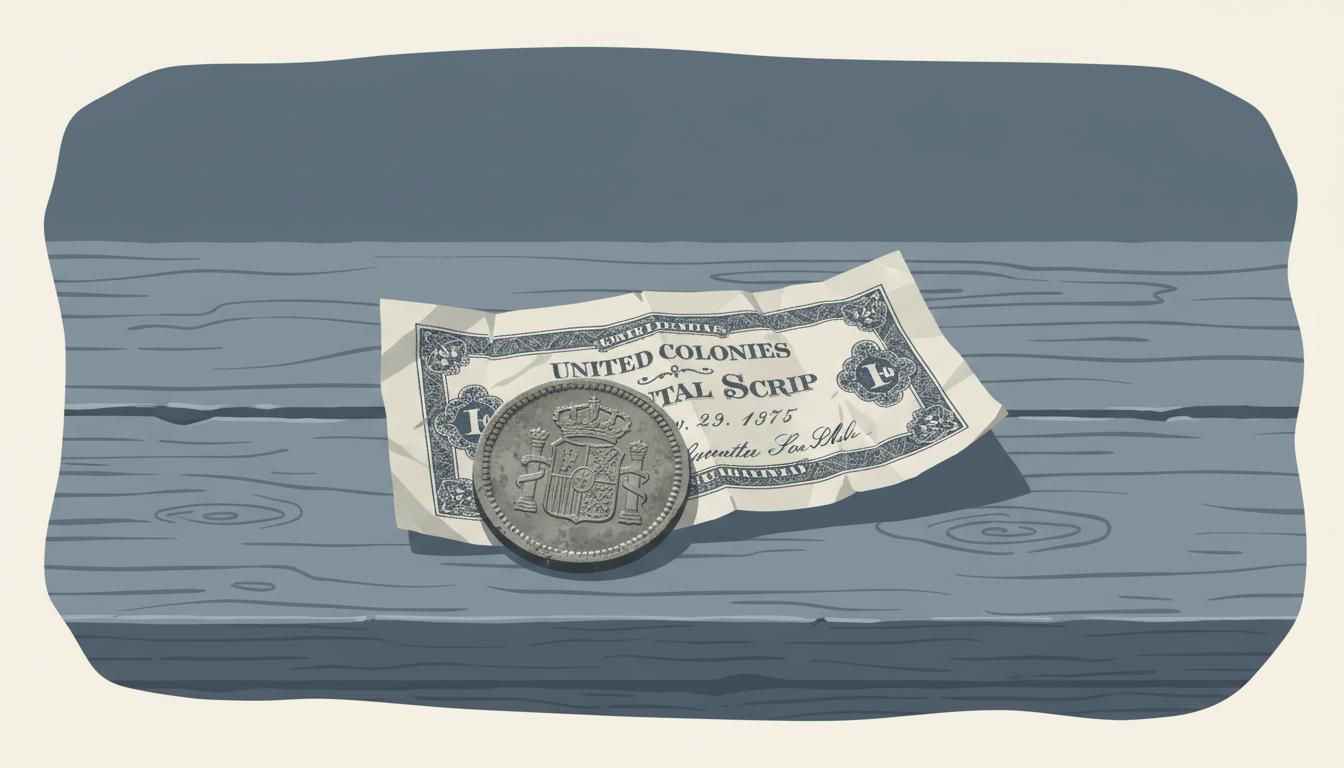
Before the United States had the dollar, conducting business was a complicated affair. Imagine trying to pay for goods with a mix of foreign coins, locally printed paper notes of questionable value, and even commodities like tobacco. This was the reality in early America, a period defined by monetary improvisation and constant uncertainty.
The colonial currency history us is a fascinating story of evolution from a chaotic barter system to a unified national currency. It highlights the critical roles played by the reliable Spanish dollar, the colonies’ own experimental paper money, and the disastrous Continental scrip of the Revolutionary War. Understanding this history reveals the foundational challenges that shaped the U.S. monetary system we know today.
The Motley Mix of Early American Money
In the 17th and 18th centuries, the American colonies faced a chronic shortage of money. The British government deliberately restricted the export of its own coins, leaving colonists to fend for themselves. This forced them to adopt a wide range of methods for trade and payment.
The economic landscape was a patchwork of different forms of currency:
- Barter: The direct exchange of goods and services without any money changing hands.
- Commodity Money: Certain goods with accepted value, such as tobacco, beaver pelts, and grain, were used as a medium of exchange.
- Foreign Coins: With no official local coinage, colonists relied heavily on coins from other nations. These included currencies from Spain, Portugal, France, and the Netherlands.
- Paper Money: To address the coin shortage, individual colonial governments began issuing their own paper bills, known as “bills of credit.”
Among this diverse collection, one coin stood out for its reliability and universal acceptance: the Spanish dollar.
The Spanish Dollar: America’s Unofficial First Currency
The Spanish dollar in American colonies was more than just another foreign coin; it became the unofficial national currency. Minted in vast quantities from the rich silver mines in Spanish America, its consistent weight and purity made it the most trusted form of money from New England to Georgia.
Known as “pieces of eight” because it was worth eight Spanish reales, this silver coin was the standard for large-value transactions. Its design was so iconic that it influenced the eventual U.S. dollar symbol ($).
From “Pieces of Eight” to “Two Bits”
One of the most practical features of the Spanish dollar was its divisibility. To make change for smaller purchases, the coin was often physically cut into eight wedge-shaped pieces, or “bits.” This practice gave rise to enduring American slang.
For example, a quarter of a dollar was literally two of these eight pieces. This is the origin of the term “two bits,” a phrase that survived long after the practice of cutting up coins ended. The stability and practicality of the Spanish dollar made it the bedrock of colonial commerce.
The Rise and Fall of Colonial Paper Money
While the Spanish dollar provided stability, there were never enough of them to meet the demands of a growing colonial economy. In response, many colonial governments began issuing paper money. These “bills of credit” were essentially IOUs, promises to be redeemed for actual coin (specie) at a future date.
However, this experiment with paper money was often fraught with problems. Without strict controls, governments frequently printed too much currency to pay for expenses, especially during times of war. This over-issuance led to predictable consequences:
- Inflation: As the supply of paper money increased, its purchasing power decreased.
- Depreciation: The value of the paper bills fell relative to stable silver coins like the Spanish dollar.
- Public Mistrust: Colonists grew wary of accepting paper money that might be worthless by the time they tried to spend it.
The Currency Act of 1764 and Rising Tensions
The British Parliament viewed the colonies’ unstable paper money with alarm, as it often complicated trade and harmed British merchants. To assert control, Parliament passed the Currency Act of 1764. According to the Library of Congress, this act forbade the American colonies from issuing their own paper currency as legal tender.
This law was not merely a financial regulation; it was seen by many colonists as a major economic grievance. It restricted their ability to manage their own economies and deepened the growing tensions that would eventually lead to the American Revolution.
A Tale of Two Dollars: Continental vs Spanish Dollar
When the Revolutionary War began in 1775, the Continental Congress faced the immense challenge of funding a war without the power to tax. Its solution was to print money. This US Revolutionary War currency, known as the Continental, was issued in large quantities to pay soldiers and purchase supplies.
The story of the Continental dollar is America’s first experiment with fiat currency, and it was a catastrophic failure. Lacking the backing of gold or silver and competing with bills issued by individual states, the currency rapidly depreciated. The over-issuance created hyperinflation, and public confidence evaporated.
By 1781, the Continental had lost nearly all of its value, leading to the popular phrase “not worth a Continental.” As Benjamin Franklin wryly observed, the currency’s depreciation acted as a hidden tax on the American people to fund the war. While the Continental collapsed, the Spanish dollar remained the reliable standard of value, used by merchants, soldiers, and even the Continental Congress itself for critical transactions.
The Legacy of Colonial Currency History in the US Constitution
The chaotic monetary experiences of the colonial and revolutionary eras left a deep impression on America’s founding fathers. The failure of countless paper money schemes, and especially the collapse of the Continental, directly influenced the writing of the U.S. Constitution.
To prevent future economic instability, the framers included clauses that gave the federal government sole power to coin money and regulate its value. The Constitution explicitly prohibited states from issuing their own “bills of credit” or making anything but gold and silver coin legal tender for the payment of debts. This was a direct reaction to the inflationary paper money of the past.
Forging a Nation’s Currency: The Coinage Act of 1792
With the Constitution in place, the final step was to create a truly American monetary system. The Coinage Act of 1792, championed by Alexander Hamilton, established the United States Mint and laid the groundwork for the nation’s currency.
Key provisions of the act included:
- The U.S. Dollar as the Standard Unit: The act formally established the dollar as the country’s main unit of currency.
- Decimal-Based System: It created a simple, decimal-based system of dimes (1/10), cents (1/100), and mills (1/1000), a major innovation at the time.
- Basing the Dollar on the Spanish Dollar: Crucially, the value of the new U.S. silver dollar was legally defined based on the weight and purity of the widely trusted Spanish dollar.
The U.S. Mint began producing its first coins, including copper cents and unpopular half cents, followed by silver and gold denominations. As the U.S. Department of the Treasury notes, even with official U.S. coins in circulation, foreign currency like the Spanish dollar remained legal tender for decades, a testament to its enduring influence.
Frequently Asked Questions
What was the most widely used currency in the American colonies before independence?
The Spanish dollar, also called pieces of eight, was the most trusted and widely circulated coin in the American colonies throughout the 18th century due to its reliable silver content.
Why did the Continental dollar lose its value during the Revolutionary War?
The Continental dollar rapidly depreciated because the Continental Congress and individual states issued excessive amounts of the paper currency without adequate backing in gold or silver, causing runaway inflation and a complete loss of public trust.
How did colonial paper money differ from the Spanish dollar?
Colonial paper money consisted of bills of credit issued by governments, which were prone to inflation and often not trusted. In contrast, the Spanish dollar was a physical silver coin with a standardized, intrinsic value that was widely accepted in international trade.
When did the United States begin issuing its own currency?
The U.S. began issuing its own official coins after the Coinage Act of 1792 established the United States Mint. However, foreign coins, especially the Spanish dollar, remained in legal circulation for many years afterward.
How did the failure of early American paper currency influence the U.S. Constitution?
The collapse of colonial and Continental paper money led the framers of the Constitution to severely restrict the monetary powers of the states. They prohibited states from issuing their own bills of credit or making anything but gold and silver coin legal tender, centralizing monetary policy at the federal level.
Conclusion
The journey from colonial scrip to a stable U.S. dollar was one of trial and error. The history of early American money is a story of practical solutions, like adopting the Spanish dollar, and painful lessons, like the failure of the Continental. This period of financial chaos and experimentation was essential in shaping the principles of sound money that were enshrined in the Constitution.
The legacy of these early currencies underscores the importance of stability and public trust in any monetary system, a foundational concept that continues to influence the history of the U.S. dollar. The struggles with colonial currency ultimately paved the way for a unified and enduring financial system for the new nation.