Bretton Woods and the US Dollar’s Fixed Exchange Role

In the aftermath of World War II, the global economic landscape was in disarray. The preceding decades had been marked by competitive currency devaluations and protectionist trade policies that stifled international commerce and contributed to global instability. To prevent a repeat of this chaos, representatives from 44 Allied nations gathered in 1944 to forge a new monetary order.
This historic conference established a system centered around the Bretton Woods US dollar fixed rate, a revolutionary approach that made the American dollar the anchor of the global economy. For nearly three decades, this arrangement dictated international finance, pegging the world’s currencies not directly to gold, but to a U.S. dollar that was itself convertible to gold. This article delves into the specific, fixed-rate role the dollar played, how it functioned, and the inherent contradictions that ultimately led to its demise.
The Dollar’s Role as Anchor Currency: A Gold-Backed Foundation
The Bretton Woods conference, held in New Hampshire, created the first fully negotiated international monetary system. Its core principle was stability, and the U.S. dollar was chosen as the foundation for that stability. At the heart of the system was a simple but powerful peg: the US dollar to gold exchange rate was fixed at $35 per troy ounce of fine gold.
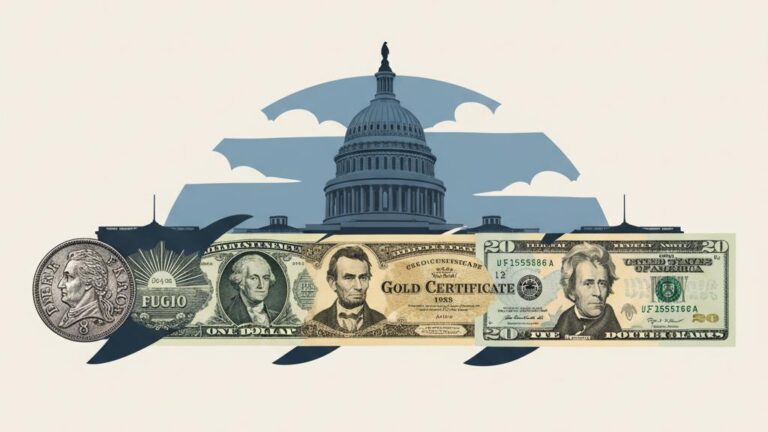
This commitment meant that foreign governments and their central banks could, at any time, exchange their U.S. dollar reserves for gold from the U.S. Treasury at this fixed rate. This direct convertibility gave the dollar immense credibility and effectively made it “as good as gold.” The U.S. held the vast majority of the world’s official gold reserves after the war, making it the only nation capable of backing its currency in this manner.
By establishing this link, the U.S. dollar became the world’s primary reserve currency. It was the standard against which all other currencies would be measured, creating a predictable framework for international trade and investment. For more on the system’s creation and collapse, see the comprehensive history of the Bretton Woods system.
The Mechanics of the Fixed Exchange Rate Dollar System
With the dollar firmly anchored to gold, the second layer of the system involved pegging all other major international currencies to the U.S. dollar. This created a “gold-exchange standard” where currencies had a fixed value in dollars, which in turn had a fixed value in gold.
The key features of this fixed exchange rate dollar system included:
- Fixed Parities: Each member country established a par value for its currency in relation to the U.S. dollar. For example, the British pound or the German Deutsche Mark would have an official exchange rate against the dollar.
- Permitted Fluctuations: To allow for minor market adjustments, currencies were permitted to fluctuate within a narrow band of 1% above or below their fixed dollar parity. If a currency’s value threatened to move outside this band, the country’s central bank was obligated to intervene in the market by buying or selling its currency to maintain the peg.
- Supporting Institutions: The conference also created two crucial institutions to oversee this new order: the International Monetary Fund (IMF) and the World Bank. The IMF acted as a sort of credit union, providing temporary financial assistance to countries facing balance-of-payments difficulties, thereby helping them defend their currency pegs without resorting to devaluation.
This structure was designed to eliminate the currency volatility that had plagued the 1930s, fostering a stable environment for post-war reconstruction and global economic growth. The system became fully operational in 1958 once European nations had recovered sufficiently to restore currency convertibility.
The Triffin Dilemma and the Bretton Woods Paradox
Despite its initial success, the Bretton Woods system contained a fundamental, and ultimately fatal, contradiction. This inherent flaw was identified in 1960 by economist Robert Triffin and became known as the Triffin Dilemma Bretton Woods.
The dilemma centered on the dual role of the U.S. dollar as both a national currency and the world’s reserve currency. For the global economy to grow, it needed an expanding supply of dollars to finance trade and serve as reserves. The only way to provide these dollars was for the United States to run persistent balance-of-payments deficits—spending more abroad than it earned.
The Core Contradiction
Herein lies the paradox:
- If the U.S. stopped running deficits, the global economy would be starved of liquidity, potentially leading to deflation and stagnation.
- But if the U.S. continued running deficits, the number of dollars held by foreign central banks would eventually swell to exceed the U.S. gold reserves. This would undermine confidence in the dollar’s convertibility at $35 per ounce and lead to a run on U.S. gold.
Triffin warned that the system was unsustainable. As predicted, the growing volume of dollars overseas began to cast doubt on the U.S. commitment to the gold peg, setting the stage for the system’s collapse.
Cracks in the Foundation: The Collapse of the Dollar Peg
By the mid-1960s, the pressures foreseen by the Triffin Dilemma began to mount. A key destabilizing factor was rising U.S. inflation, driven by spending on the Vietnam War and domestic social programs. This inflation made American goods more expensive, worsened the U.S. balance of payments deficit, and made holding gold at the fixed price of $35 an ounce increasingly attractive.
Several key events signaled the breakdown:
- 1967: For the first time, foreign claims on U.S. gold officially exceeded the total U.S. gold reserves. In November of that year, the United Kingdom was forced to devalue the pound, sending shockwaves through the system.
- 1968: A speculative run on the London Gold Pool, an arrangement of central banks meant to stabilize the price of gold, forced its collapse. This put even more pressure on the U.S. to maintain the $35 peg alone.
- 1962-1971: The U.S. Federal Reserve implemented policies like “Operation Twist” and dramatically increased currency swap lines from $900 million to over $11 billion in an attempt to protect its dwindling gold reserves.
Despite these efforts, speculative attacks against the dollar intensified. By May 1971, Germany and the Netherlands gave up defending the peg and allowed their currencies to float, a clear sign that the system was unraveling.
The Nixon Shock: Severing the Dollar-Gold Link
The definitive end of the Bretton Woods US dollar fixed rate system came on August 15, 1971. Facing relentless speculative attacks and a rapid depletion of U.S. gold reserves, President Richard Nixon announced a series of dramatic economic measures.
In what became known as the “Nixon Shock,” he unilaterally and immediately suspended the convertibility of the U.S. dollar into gold. He also imposed a 10% surcharge on imports to pressure other countries to revalue their currencies against the dollar. As detailed by Federal Reserve History, this move “closed the gold window” and severed the final link between the world’s currencies and gold.
Though an attempt was made to revive the fixed-rate system with the Smithsonian Agreement in December 1971—which devalued the dollar by about 10.7%—it was short-lived. Renewed speculation forced most major currencies to abandon their pegs and transition to floating exchange rates by March 1973. The era of the dollar’s role as anchor currency in a fixed system was over, fundamentally reshaping the history of the U.S. dollar as a reserve currency.
The end was formally ratified by the Jamaica Accords in 1976, which legitimized the floating rate system that persists today. This ushered in a new era where the U.S. dollar remains the world’s primary reserve currency, but its value is determined by market forces rather than a fixed peg to gold.
Frequently Asked Questions
What was the dollar’s fixed rate under Bretton Woods?
Under the Bretton Woods system, the U.S. dollar was fixed to gold at a rate of $35 per troy ounce. This rate was the anchor of the entire system, as all other member currencies were then pegged to the U.S. dollar at a fixed parity.
Why was the Triffin Dilemma so critical to the system’s failure?
The Triffin Dilemma was critical because it exposed the system’s core contradiction. To supply the world with liquidity (dollars), the U.S. had to run deficits, but doing so would eventually erode confidence in its ability to back those dollars with its limited gold supply. This inherent instability made the system’s collapse almost inevitable over the long term.
What ultimately replaced the fixed dollar standard?
The fixed dollar standard was replaced by a system of floating exchange rates. In this modern system, the values of currencies are determined by supply and demand in the foreign exchange market, rather than being pegged to the dollar or gold. This regime was formally adopted in 1976 and continues to be the basis for international finance.
Conclusion
The Bretton Woods system’s decision to establish a fixed rate for the U.S. dollar, backed by gold, was a monumental effort to create global economic stability. For approximately 15 years of effective operation, it succeeded in fostering unprecedented growth and international cooperation. The dollar’s role as the anchor currency provided a predictable and reliable standard that rebuilt the world economy.
However, the system’s reliance on the dollar also contained the seeds of its own destruction. The Triffin Dilemma proved that the arrangement was fundamentally unsustainable, and by 1971, economic and political pressures forced its abandonment. The collapse of the fixed-rate regime marked a pivotal moment, leading directly to the flexible, market-driven currency system we know today. To understand the full context of this historic era, explore the complete history and demise of the Bretton Woods system.