The History of National Currencies in the Eurozone (Pre-Euro)

Before the seamless transactions and unified banknotes of today, Europe was a mosaic of distinct national currencies, each telling a story of sovereignty, economic struggle, and cultural identity. From the stable German Mark to the often-volatile Italian Lira, these monetary symbols were deeply woven into the fabric of daily life. Understanding the eurozone national currency history is to trace the ambitious journey from a continent of separate economies to a powerful, integrated monetary union.
This article explores the legacies of the key national currencies that were retired to make way for the euro. We will delve into their unique histories, their role in shaping their nations, and the monumental process that led to their replacement, marking one of the most significant economic transformations of the modern era.
The Path Towards a Single European Currency
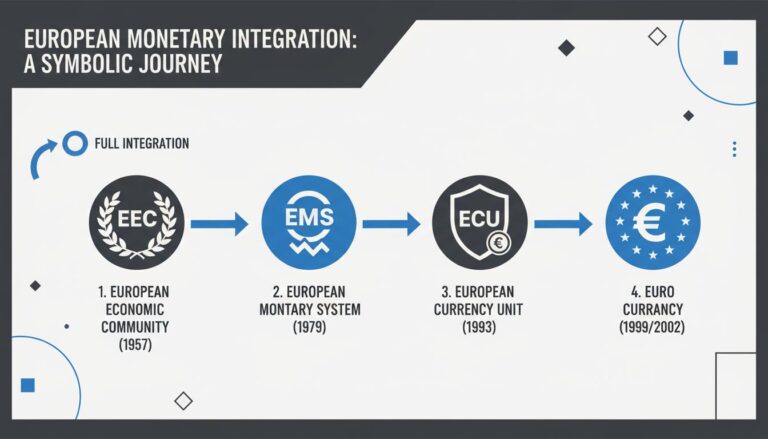
The vision of a united European economy emerged from the ashes of World War II, driven by a desire for lasting peace and prosperity. The first major step was the 1957 Treaty of Rome, which established a common market but stopped short of proposing a monetary union. For decades, the idea remained an ambition rather than a concrete plan.
Momentum grew with the 1970 Werner Report, the first formal blueprint for a monetary union, though its progress was halted by economic turbulence. It wasn’t until the 1989 Delors Report that a clear, three-stage path was laid out. This roadmap called for converging economic policies and creating an independent European Central Bank to oversee a single currency.
This process was formalized by the landmark Maastricht Treaty of 1992. This treaty made the Economic and Monetary Union (EMU) a legally binding objective and established strict “convergence criteria” that member states had to meet, covering inflation, government debt, and interest rate stability. This set the stage for the eventual creation of the euro and the end of many historic currencies.
Pre-Euro National Currencies: Pillars of European Economies
Before the euro, each nation’s currency was a pillar of its economy and a reflection of its unique history. Four currencies, in particular, played pivotal roles in shaping the economic landscape that would eventually form the eurozone.
The French Franc (FRF): A Legacy of Revolution and Resilience
The french franc history began in 1795, following the French Revolution, establishing it as one of Europe’s most enduring decimal currencies. For over two centuries, the franc (FRF) navigated immense political and economic turmoil, including wars, occupations, and financial crises, yet it remained a potent symbol of French identity and economic power.
The franc’s stability made it a cornerstone of the European monetary system in the post-war era. Its replacement was a deeply symbolic moment for France, with many citizens mourning the loss of a national icon. On January 1, 2002, the franc was officially replaced at a fixed conversion rate of 1 euro = 6.55957 francs.
The German Mark (DEM): An Anchor of Stability
Introduced in 1948 as part of West Germany’s post-war economic reforms, the Deutsche Mark (DEM) quickly became the embodiment of the nation’s economic miracle, or Wirtschaftswunder. The german mark pre-euro era was defined by its incredible stability and the anti-inflationary discipline of the German Bundesbank. This steadfast reputation made the mark a major global reserve currency.
The mark’s trustworthiness was so high that it served as the anchor for the European Exchange Rate Mechanism (ERM), the system designed to reduce currency volatility before the euro’s launch. This credibility was crucial in building public trust in the forthcoming euro. For many Germans, giving up the stable mark was an emotionally difficult sacrifice for European unity. The final conversion rate was 1 euro = 1.95583 marks, a testament to the Deutsche Mark’s economic strength.
The Italian Lira (ITL): A Story of Unification and Volatility
The italian lira history started with the country’s unification in 1861. The lira (ITL) symbolized Italy’s economic journey, reflecting both its remarkable post-war recoveries and its persistent struggles with inflation and devaluation. Especially during the 1970s and 1980s, the lira was known for its chronic weakness, requiring large denominations for everyday purchases.
For Italy, adopting the euro was a double-edged sword. On one hand, it offered a welcome escape from recurring currency crises and provided much-needed price stability. On the other, it meant surrendering the ability to devalue the currency to boost exports—a key, albeit controversial, policy tool. The lira was converted at a rate of 1 euro = 1,936.27 lire.
The Belgian Franc (BEF): A Reflection of Integration
The history of the belgian franc dates back to 1832, shortly after Belgium gained independence. For much of its existence, it operated in a monetary union with the Luxembourg franc, a precursor to the broader European integration it would later embrace. The franc (BEF) fueled Belgium’s industrialization and was central to its role as a founding member of the European Union.
The transition to the euro in Belgium was relatively smooth, reflecting the nation’s long-standing commitment to European cooperation. Despite this, some public perceptions of price increases lingered after the changeover. The Belgian franc was replaced at a rate of 1 euro = 40.3399 francs.
The Great Transition: A Two-Phase Currency Changeover
The shift from a dozen national currencies to a single one was an unprecedented logistical challenge, executed in two main phases to ensure a smooth transition.
- The Virtual Launch (1999-2001): On January 1, 1999, the euro was introduced as an electronic currency for accounting and bank transfers. For three years, it existed virtually, running in parallel with national currencies. During this period, the exchange rates between the 11 founding members’ currencies and the euro were irrevocably fixed.
- The Physical Launch (2002): The most visible step occurred on January 1, 2002, when euro banknotes and coins entered circulation in 12 countries (Greece having joined in 2001). This event marked the largest cash changeover in history, directly impacting hundreds of millions of people. Within a few months, national currencies like the franc, mark, and lira were withdrawn and ceased to be legal tender.
This carefully managed process successfully retired centuries of monetary history, cementing the euro’s place in the daily lives of Europeans. For more details on this historic event, explore the official history and purpose of the euro.
The Legacy and Impact of Retiring National Currencies
The replacement of historic currencies with the euro brought profound changes, creating both opportunities and challenges. Economists widely acknowledge the significant benefits, including:
- Price Stability: The euro helped tame inflation in countries that previously had volatile currencies, like Italy and Spain.
- Lowered Transaction Costs: It eliminated currency exchange fees for trade and travel within the eurozone, boosting commerce.
- Increased Price Transparency: Consumers could easily compare prices across borders, fostering competition.
However, the transition was not without its difficulties. The loss of monetary sovereignty meant countries could no longer independently adjust interest rates or devalue their currency to combat economic downturns. This constraint became a major point of contention during the European sovereign debt crisis, highlighting the challenges of a “one-size-fits-all” monetary policy for diverse economies.
Today, the euro is used by over 350 million people in 20 countries and stands as the world’s second most traded currency after the US dollar. It remains a powerful symbol of European integration, built upon the foundations of the national currencies it replaced. As noted by the European Parliament, its journey reflects decades of political and economic cooperation.
Frequently Asked Questions
When did the euro officially replace most European national currencies?
The euro officially replaced national currencies for everyday transactions on 1 January 2002, when euro banknotes and coins entered circulation in 12 countries. The virtual launch for accounting purposes had already occurred on 1 January 1999.
What were the main national currencies replaced by the euro?
Key currencies replaced by the euro included the German Mark (DEM), French Franc (FRF), Italian Lira (ITL), Spanish Peseta (ESP), Dutch Guilder (NLG), and Belgian Franc (BEF), among others from the initial member states.
What criteria did countries need to meet to adopt the euro?
Countries had to fulfill the strict Maastricht convergence criteria, which mandated low inflation, controlled government deficits and debt, stable exchange rates within the European Exchange Rate Mechanism (ERM), and convergent long-term interest rates.
Conclusion
The story of the eurozone’s national currencies is a powerful narrative of transformation. It charts a deliberate evolution from symbols of national sovereignty like the French franc and German mark to the shared destiny embodied by the euro. This transition was far more than a technical currency swap; it was a profound political, economic, and cultural shift that reshaped the continent.
While the legacies of the lira, franc, and mark live on in history, their replacement paved the way for a new chapter of European integration. The journey reflects a long-held ambition for unity and prosperity, making the eurozone national currency history a central element of Europe’s modern economic identity.